Domestic cats
All Creatures Great and SmallSusie and Arthur, the two cats cared for by Miss Stubbs, belong to a household in which animals are her chief concern and the focus of James Herriot’s regular visits. Susie’s frailty and Arthur’s calm dignity give the pair contrasting presence, while Miss Stubbs’s anxiety about what will become of her animals after death reveals how closely their companionship is bound to her sense of love, faith, and security.
The Cats in Miss Stubbs’s Household
The cats share Miss Stubbs’s crowded cottage with her dogs. For more than a year, James Herriot’s visits have followed a familiar pattern: the dogs bark from the bed, Mrs. Broadwith moves the animals into the back kitchen so the examination can take place, and tea and conversation follow. Once the dogs are let out again, Arthur and Susie come into the room and rub themselves against Herriot’s trouser legs. Their return is part of the household’s ordinary rhythm, not an interruption of it. The small, repeated details of a veterinary call—an examination, a cup of tea, animals milling around the bed—show how care for the cats is woven into the routines that sustain Miss Stubbs’s life.
That care matters particularly because Miss Stubbs is confined to bed and does not discuss her own illness and pain with Herriot. Her attention instead rests on her three dogs and two cats. The cats are not merely present in the room: their needs give her a continuing subject of concern, and their company is part of the world she can still tend and share. The contrast between her physical dependence and her attention to the animals gives their companionship practical as well as emotional weight.
Susie’s Vulnerability and Arthur’s Composure
The two cats require different kinds of attention. Susie is scraggy, and Herriot repeatedly kneads her abdomen to check for signs of lymphosarcoma. This is a watchful examination, not a confirmed diagnosis: the text presents a possibility he fears and monitors. Her condition makes the veterinary visit an ongoing act of vigilance, with uncertainty remaining part of her care.
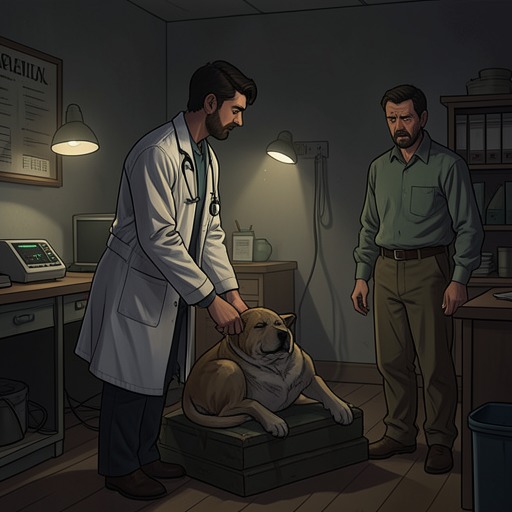
Arthur, by contrast, is the healthiest of the animals, with no evident complaint beyond tartar on his teeth. At Miss Stubbs’s request, Herriot hauls the large cat across the bedspread and opens his mouth. Arthur is a huge grey neutered tom, described through a striking combination of benevolence and dignity. His manner challenges the familiar idea that cats are cold or selfish: his fine eyes and broad face seem tolerant of the world, and his movements retain an air of composure even during treatment.
As Herriot scrapes Arthur’s teeth, the cat purrs so loudly that his chest echoes like a distant motor. Nobody needs to hold him down; he sits placidly through the procedure. When a forceps accidentally nicks his gum while Herriot cracks tartar from a back tooth, Arthur raises one massive paw in mild warning, but keeps his claws sheathed. The gesture gives him an unmistakable presence in the examination: he registers discomfort and sets a limit without turning the encounter into a struggle. His cooperation does not make him passive; it is a measured response from an animal whose trust and composure remain visible even when treatment hurts.
Attachment, Mortality, and Reassurance
The cats’ place in Miss Stubbs’s life comes into sharpest focus when Ben, one of her dogs, dies. After Herriot returns to sit beside her, Miss Stubbs says that she believes her own death will come next. Her fear is not limited to leaving the world she knows. She worries that she may never see her dogs and cats again, despite expecting to be reunited with her human family. The question of animal souls, raised by what she has read and by religious beliefs she has encountered, makes the possible separation from the cats a spiritual as well as an emotional threat.
Herriot answers by linking the idea of a soul to the animals’ capacity for love, loyalty, and gratitude. When Miss Stubbs asks him to be absolutely honest rather than simply reassuring, he admits uncertainty about much of the subject but says he truly believes that the animals will go wherever she is going. His answer does not establish a general religious doctrine; it is a personal conviction offered to a woman whose attachment to her animals has become inseparable from her hope of reunion. Miss Stubbs recognizes the sincerity of his belief, and the exchange restores calm after the bluntness of her fear.
A Future Beyond the Cottage
In a later visit, Mrs. Broadwith is settled in a new home with a large stretch of garden, and she says the animals are outside. When she opens the door, the old companions stream in. Arthur jumps onto Herriot’s knee and arches against his arm, his purr rising above the dogs’ barking; the wheezy Prince also greets him. The cats’ arrival confirms their place in the household beyond the familiar cottage room: they have remained together with their animal companions and are welcomed into a new setting.
Arthur’s immediate, physical affection makes this change legible without explanation. Earlier he had accepted examination with dignified patience; now he presses himself against the visiting veterinarian. Susie is not singled out in this reunion, but she is among the animals Mrs. Broadwith has kept in the garden and lets back into the room. Their continued presence answers, in practical terms, the anxiety that had troubled Miss Stubbs: the cats remain cared for and together with the other animals who formed her household. Across clinical routine, private fear, and relocation, Susie and Arthur represent not an abstract claim about animals but particular lives bound to human care—and the enduring hope that such attachment need not end in separation.